

Essential books on health and global development
Explore groundbreaking publications by Dr. Akwo Thompson Ntuba and leading voices. Discover key frameworks designed to transform personal well-being, empower public health leaders, and drive sustainable growth across cities and nations.
Featured releases by Chief editor Dr. Akwo Thompson Ntuba
Gain actionable insights into governance, climate adaptation, and healthcare equity with these core releases, available directly in digital and print formats or via major book distributors.

Health is human rights
A critical examination of universal healthcare accessibility, exploring why equitable wellness systems are essential foundational rights for thriving global communities.

From climate to community
Connecting environmental policy with grassroots social action, this work guides local stakeholders in navigating modern climate challenges and community well-being.

Advising mayors
A strategic roadmap for municipal leadership, offering proven guidance on building resilient urban infrastructures and community-centered health programs.
Knowledge that drives lasting social impact
Reading our curated publications equips leaders, students, and practitioners to translate research into active contributions for their cities, regions, and international development goals.

Direct orders and instant digital downloads
Access our publications in the format that best fits your workflow. Order print copies directly through our platform, download immediate e-book editions for your research, or purchase across external digital book retail partners worldwide.
Connecting literature to public action
Every book featured across Healthndevelopment Week aligns with the topics debated during our annual conferences, Health Fest, and Development Fest. Engage with our ongoing educational initiatives and editorial analyses.


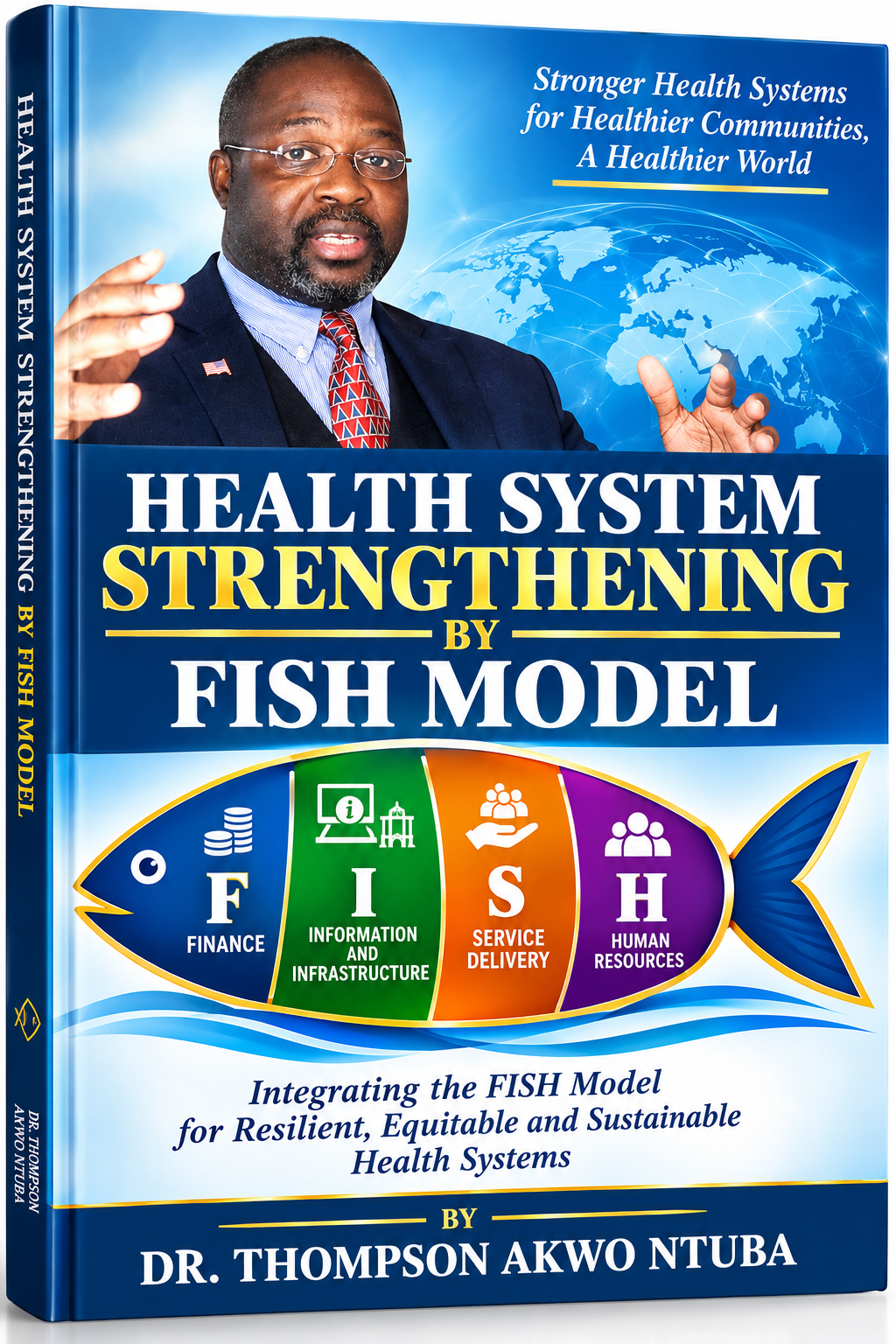
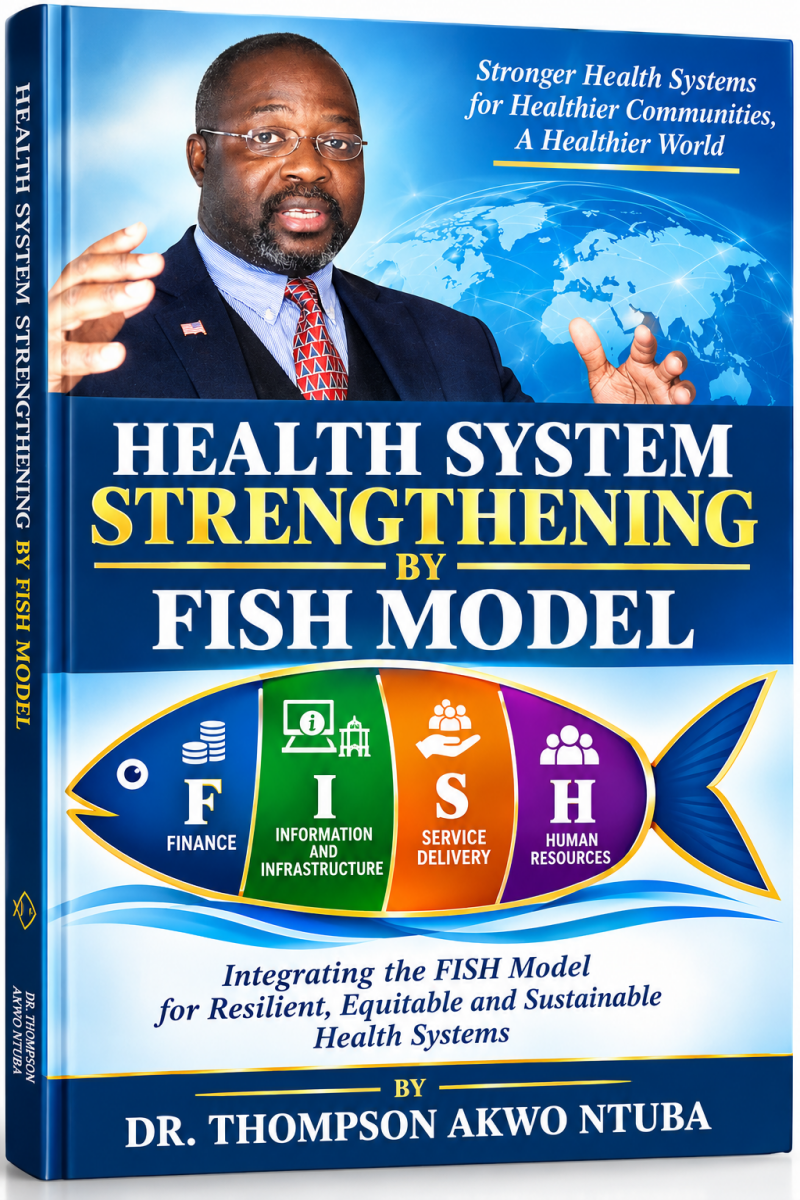

Finance • Information & Infrastructure • Service Delivery • Human Resources
By Dr. Thompson Akwo Ntuba
Book Summary
Health System Strengthening by FISH Model presents a practical framework for understanding, assessing, and strengthening health systems through four interconnected pillars: F — Finance, I — Information and Infrastructure, S — Service Delivery, and H — Human Resources.
Drawing from Dr. Thompson Akwo Ntuba’s nearly three decades of experience in medicine, global health, health and development communication, community-based programs, consulting, government and institutional engagement, humanitarian outreach, and international health documentation, the book examines health systems not simply as hospitals and clinics, but as interconnected structures that depend upon people, resources, information, infrastructure, financing, and effective delivery of services.
The FISH Model
F — Finance
A health system requires sustainable financing to function. The book examines the importance of health financing, resource mobilization, budgeting, insurance, investment, accountability, and equitable allocation of resources. Without adequate and sustainable financial foundations, even well-designed health programs can struggle to reach the populations they are intended to serve.
I — Information and Infrastructure
Information enables health systems to understand populations, identify needs, monitor programs, make decisions, and evaluate results. Infrastructure provides the physical and technological foundation through which services can operate. This pillar brings together health information, communication, data, facilities, equipment, technology, transportation, and other essential infrastructure.
S — Service Delivery
The ultimate purpose of a health system is to provide accessible, acceptable, affordable, equitable, and quality services. The book considers service delivery from the perspective of communities and institutions, including prevention, primary care, treatment, health education, outreach, public health, emergency response, and other services required to improve health outcomes.
H — Human Resources
Health systems depend upon people. Physicians, nurses, pharmacists, community health workers, administrators, researchers, communicators, technicians, volunteers, policymakers, and other professionals form the human foundation of health systems. The book emphasizes workforce development, leadership, training, retention, collaboration, ethics, and the importance of putting people at the center of health-system strengthening.
An Integrated Model
The FISH Model is built on the idea that these four pillars cannot be treated independently.
Finance supports infrastructure and people.
Information guides decisions and service delivery.
Infrastructure enables services.
Human resources operate the system.
Service delivery demonstrates whether the system is functioning effectively.
A weakness in one area can affect the others. A health system may have trained professionals but inadequate financing. It may have financing but insufficient infrastructure. It may have facilities but inadequate information systems. It may have information and infrastructure but insufficient personnel to deliver services.
The FISH Model therefore encourages policymakers, health professionals, development organizations, communities, educators, and health managers to look at the whole system and the relationships among its components.
From Global Health to Community Health
A distinctive feature of the book is its emphasis on field-based and community-based experience. Through the HealthNDevelopment approach, Dr. Ntuba has documented health and development activities across communities, cities, institutions, conferences, government settings, businesses, universities, faith communities, and international organizations.
The book connects these experiences to broader questions of:
- global health management and leadership;
- health equity and minority health;
- community engagement;
- health communication;
- public-private and institutional partnerships;
- health insurance and financing;
- environmental and climate-related health challenges;
- humanitarian and medical outreach;
- faith and health;
- health education and empowerment;
- policy and governance;
- documentation and preservation of health history.
In this sense, the FISH Model is presented not merely as a theoretical diagram, but as a framework for observing real health systems and asking practical questions about what works, what is missing, and what can be strengthened.
The Role of Communication and Documentation
The book also reflects Dr. Ntuba's long-term work through HealthNDevelopment Magazine & Media and Health Consulting International. Communication, documentation, journalism, photography, video, conferences, books, and community engagement provide another way of understanding health-system development.
The philosophy behind the work can be summarized as:
Books preserve thinking; conferences preserve conversations; consulting records institutional contribution; media documents experience; and museums preserve history.
Through this perspective, health-system strengthening becomes both a present-day development responsibility and a historical record of how communities and institutions respond to health challenges.
Purpose of the Book
Health System Strengthening by FISH Model is intended as a resource for health professionals, global health practitioners, policymakers, development organizations, students, researchers, community leaders, consultants, faith-based organizations, and institutions seeking a practical way to examine health-system capacity.
Rather than presenting health as the responsibility of one profession or one institution, the book encourages multidisciplinary and multisectoral collaboration.
Its central message is that stronger health systems require more than medical treatment. They require sustainable financing, reliable information and infrastructure, effective service delivery, and capable human resources working together.
FISH Model at a Glance
F — FINANCE
Resources to sustain the system
I — INFORMATION & INFRASTRUCTURE
Knowledge, data, facilities and technology to support the system
S — SERVICE DELIVERY
Accessible and quality services reaching people and communities
H — HUMAN RESOURCES
The people, skills, leadership and workforce that make the system function
Core Proposition
A healthy population requires a functioning health system, and a functioning health system requires the four foundational elements of the FISH Model to work together.
This book therefore proposes the FISH Model as a practical lens for examining, communicating, teaching, documenting, managing, and strengthening health systems—from the community level to national and global health systems.
Create Your Own Website With Webador