

A Church, a Community, and a Living History: My COBES Journey Along Martin Luther King Jr. Boulevard
By Rev. Dr. Thompson Akwo Ntuba
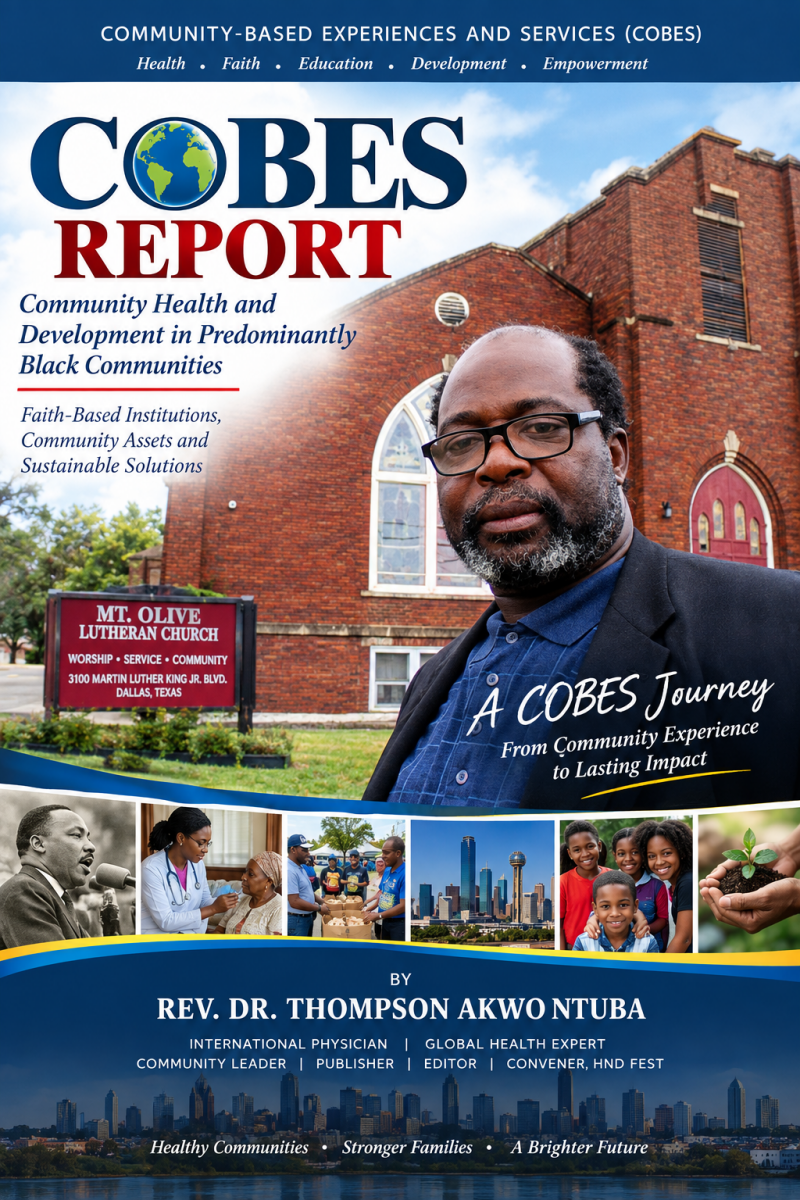
Standing before this historic church on Martin Luther King Jr. Boulevard in Dallas, I am reminded that community health and development cannot be separated from the history, faith, struggles, resilience, and aspirations of the people who live in a community.
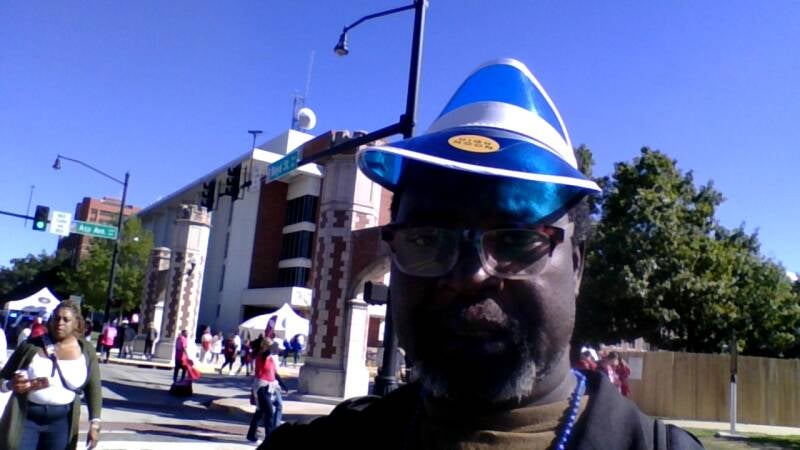
The photograph captures one moment in my continuing journey of Community-Based Experiences and Services (COBES)—a journey that has taken me into communities, churches, neighborhoods, health institutions, schools, government offices, and places where ordinary people are working every day to build better lives.
The church in this photograph is Mount Olive Lutheran Church, 3100 Martin Luther King Jr. Boulevard, Dallas, Texas. Historical Dallas directories document the congregation at this address decades ago, and the church remains a community institution today. mountolivedallas.org
A Church at the Heart of a Community
For me, a church is much more than a building.
A church can be a place of worship, but it can also become a place of healing, education, social support, community organization, food assistance, counseling, advocacy and hope.
That is why I approach churches through the lens of health and development.
The Bible teaches:
“Let us not love in word, neither in tongue; but in deed and in truth.”
—1 John 3:18
This principle has deeply influenced my understanding of ministry and community development. Faith must ultimately be translated into service.
In Dallas, Mount Olive's contemporary community work illustrates this principle. Its community ministries have included food assistance, and a partner account reports hundreds of weekly food bags being distributed through the church to people in need. CLCDallas
This is the kind of connection I look for when I document communities: Where are people worshipping? Where are they receiving help? Where are they being educated? Where are they finding hope? And what health and social-development needs remain unmet?
Martin Luther King Jr. Boulevard as a Classroom
Being on Martin Luther King Jr. Boulevard gives the experience another dimension.
The name itself represents a profound history of African American struggle for civil rights, dignity, equality and community empowerment. The surrounding neighborhood therefore becomes more than a geographic location. It becomes a living classroom.
As I document predominantly Black communities, I do not want to document only problems.
I want to document people.
I want to see the churches, businesses, schools, families, health professionals, community leaders, young people, elders, social-service organizations and volunteers who are creating solutions.
There is a tendency in some forms of community reporting to photograph poverty without photographing resilience. My approach through COBES is different.
I ask:
What are the assets of this community?
What institutions are already present?
What knowledge exists within the community?
What role can faith institutions play in health promotion?
How can community members participate in defining their own development priorities?
From COBES to Global Health
My COBES philosophy began with a simple conviction: you cannot understand a community from a distance.
You have to enter it.
You have to listen.
You have to observe.
You have to serve.
You have to document.
And, when possible, you have to help connect community experience with institutions and resources that can produce sustainable change.
That philosophy has followed me from Africa to Europe and the United States.
My work in community health has therefore never been limited to the clinic or hospital. I have increasingly viewed the community itself as part of the health system.
A church can influence health behavior.
A school can influence nutrition and physical activity.
A community leader can influence vaccination and preventive care.
A journalist can influence public understanding.
A physician can translate scientific information into understandable language.
A local government can influence the physical and social determinants of health.
And a faith community can mobilize people when conventional systems cannot reach them.
The Church and the Health of Black Communities
My documentation of predominantly Black communities is especially important because health disparities are not simply medical problems.
They are also questions of history, economics, education, housing, environment, transportation, employment, access to healthy food, social support and trust in institutions.
The church frequently stands at the intersection of these issues.
A congregation may know which elderly person lives alone.
It may know which family has lost employment.
It may know which young person needs mentorship.
It may know which household needs food.
It may know where addiction, violence, homelessness or social isolation are affecting people.
That local knowledge is enormously valuable to public health.
The challenge is to build respectful partnerships between faith communities, health professionals, public-health institutions, government and community organizations.
Documentation Is Also a Form of Service
When I stand with my camera and document a church like this, I am not merely taking a photograph.
I am creating an archive.
Over nearly three decades, I have increasingly understood that documentation itself can become a form of service.
A photograph preserves a moment.
A video preserves a voice.
An interview preserves testimony.
A newspaper article preserves public discussion.
A conference preserves professional knowledge.
A community visit preserves institutional memory.
Together, these materials can tell the story of how communities lived, struggled, served and changed.
This is one reason I have continued developing HealthNDevelopment Magazine & Media and the broader HealthNDevelopment Week platform: to connect health, development, communication, journalism, education and documentation.
Faith and Community Development
My Christian understanding of community development is rooted in the example of Jesus.
Jesus repeatedly went where people were.
He taught in public spaces.
He entered homes.
He spoke with people who were marginalized.
He fed people.
He healed people.
He listened to people.
He restored dignity.
That model challenges me to think about ministry beyond the walls of a sanctuary.
The Great Commission says:
“Go ye therefore, and teach all nations...”
—Matthew 28:19
For me, “go” is important.
Go into the city.
Go into the neighborhood.
Go into the village.
Go into the hospital.
Go into the school.
Go into the church.
Go into the streets.
Go where people are.
And when we arrive, we should not arrive merely to speak. We should arrive to listen, learn, serve and build relationships.
My Dallas COBES Experience
My presence at this church is therefore part of a larger documentary journey through Dallas and other American cities.
I have been interested in how communities organize themselves around health, faith, government, education, social services and economic development.
In neighborhoods with large Black populations, I have sought to understand both the historical challenges and the contemporary innovations.
I have also learned that communities should not be defined exclusively by statistics about disease, poverty or inequality.
Behind every statistic is a human being.
Behind every neighborhood is a history.
Behind every church is a congregation.
Behind every congregation are families.
And behind every family are hopes for the future.
From the Church to the City
The church also reminds me that urban health must be understood at the city level.
Martin Luther King Jr. Boulevard is not isolated from the rest of Dallas.
It is connected to transportation, housing, employment, schools, hospitals, businesses, parks, food systems, policing, local government and economic development.
Therefore, urban ministry and urban health require an integrated approach.
This is consistent with my broader work in health systems strengthening.
I describe my FISH model as:
F — Finance
I — Information and Infrastructure
S — Service Delivery
H — Human Resources
But community institutions add another essential dimension: trust and social capital.
A technically excellent health system can still fail if people do not trust it.
A church can sometimes become a bridge between institutions and residents because relationships have already been established.
Remembering the Past, Serving the Present, Building the Future
The photograph of me standing before this church therefore becomes part of my larger personal archive.
I see three dimensions in it:
Memory.
We remember the people and institutions that helped build these communities.
Mission.
We document the continuing work of churches, health professionals, community leaders and residents.
Future.
We ask what must be done so that the next generation can live healthier and more prosperous lives.
This is the essence of my COBES philosophy.
I have traveled across African cities, European cities and American cities, but everywhere I have gone, I have found the same fundamental human questions:
How do we live?
How do we remain healthy?
How do we care for one another?
How do we educate our children?
How do we protect the vulnerable?
How do we build communities?
How do we preserve our history?
And how do we leave the next generation something better than what we inherited?
My Reflection
As Rev. Dr. Thompson Akwo Ntuba, I consider this photograph more than a personal photograph.
It is a document of community health, faith, history and development.
The church behind me represents an institution rooted in a neighborhood. Martin Luther King Jr. Boulevard represents a larger American history. My presence represents my continuing COBES journey—entering communities, observing, learning, communicating and documenting.
I believe that health is lived in communities before it is treated in hospitals.
I believe that development begins with people.
I believe that faith communities can be important partners in public health.
And I believe that documentation preserves lessons that future generations can use.
My prayer is that the photographs, interviews, reports, books, films and archives accumulated through my nearly three decades of work will not simply become a record of where I have been.
May they become a resource for those who come after me.
May they help communities tell their own stories.
May they encourage physicians, pastors, journalists, public-health professionals, policymakers and community leaders to work together.
And above all, may the work continue the biblical call:
“Seek the peace of the city... and pray unto the LORD for it: for in the peace thereof shall ye have peace.”
—Jeremiah 29:7
This is my COBES journey: from community experience to documentation, from documentation to knowledge, from knowledge to service, and from service toward healthier and more just communities.
https://www.youtube.com/watch?v=8AAMAj52DPM

Create Your Own Website With Webador