
UNGA 81 session highlights
Explore our dedicated coverage of the 81st United Nations General Assembly in New York. Discover pivotal discussions advancing Sustainable Development Goal 3 (SDG 3), global diplomacy, and the social, economic, and environmental determinants of health.

High-level addresses and leadership
A defining moment of UNGA 81 features the host country address by the President of the United States alongside landmark presentations from outgoing UN Secretary-General António Guterres. These keynotes set a collaborative tone for multilateral dialogue and renewed international commitment to global progress.

Global health summits and SDG 3
High-level meetings convened in collaboration with the World Health Organization put SDG 3 at the forefront. Leaders and educators examine the critical intersections of health equity, pandemic preparedness, and systemic determinants of well-being across vulnerable communities.

Partner with HEALTHNDEVELOPMENT
Bridging diplomatic consensus with educational action requires sustained collaboration. Partner with HEALTHNDEVELOPMENT to amplify health literacy, translate UNGA insights into impactful policy, and build thriving, resilient communities worldwide.
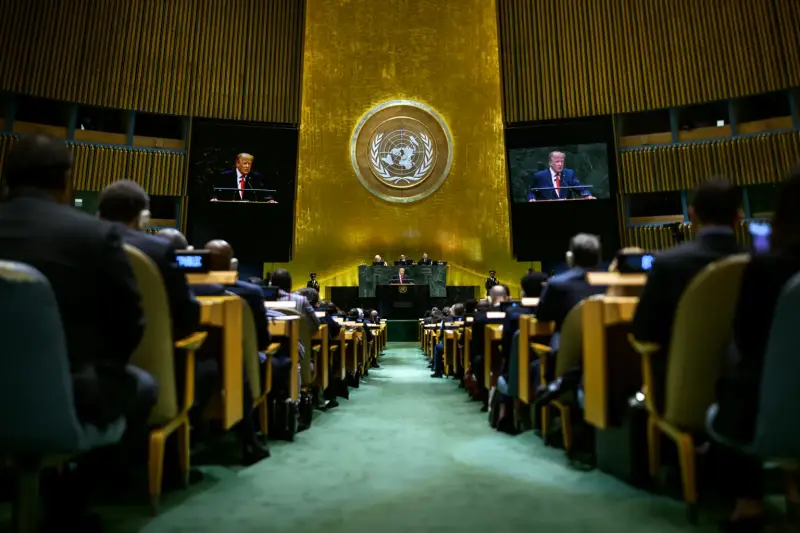
Key Takeaways From Trump’s 81st U.N. General Assembly Address in New York
Key Takeaways From Trump’s 81st U.N. General Assembly Address in New York
President Donald Trump addressed the 81st session of the United Nations General Assembly in New York on September 22, 2026, presenting a broad argument that the United States has entered a period of renewed military, economic and diplomatic strength. The speech focused heavily on American sovereignty, Iran, security in the Western Hemisphere, immigration, international institutions and artificial intelligence. The White House+1
Below are the major themes and takeaways from the address.
1. Trump’s central message: “America is back”
The speech opened with a declaration that the United States has regained strength and confidence after 250 years of American history. Trump repeatedly contrasted his administration's approach with what he described as years of inaction by previous governments.
“America is back, and our country is stronger today than ever before.”
A recurring theme was the idea that problems should be confronted rather than postponed. Trump framed his foreign-policy approach around action, deterrence and the use of American power. The White House similarly characterized the speech as a message of American strength and resolve. The White House
2. Iran and nuclear weapons dominated the foreign-policy message
Iran was one of the most important subjects in Trump's address. He argued that preventing Iran from obtaining a nuclear weapon was a central American security objective and presented his administration's military action against Iran as a response to what he described as a long-standing threat.
Trump said the United States had given Iran opportunities to negotiate before taking military action. He also called on other countries to maintain pressure on Tehran.
The speech therefore presented Trump's Iran policy as an example of his broader philosophy: diplomacy backed by the credible threat—and, in his telling, the actual use—of American military power. Reuters reported that Trump also warned that Iran could face devastating consequences if an agreement was not reached. Reuters+1
3. September 11 and October 7 were used to frame the security argument
Trump connected the Iranian threat to two major terrorist attacks: September 11, 2001, and the October 7, 2023, attack in Israel.
He recalled the 25th anniversary of the September 11 attacks and said that the proximity of the U.N. headquarters to Ground Zero made the anniversary particularly significant. He then referenced the upcoming third anniversary of October 7 and argued that Iran's support for militant groups represented a continuing international-security challenge. The American Presidency Project+1
Trump also cited figures concerning deaths inside Iran, including his claims that more than 72,000 people had been killed by the Iranian regime and that 10,000 protesters had recently been killed. Those figures should be treated as claims made in the speech rather than independently established facts; reporting has noted that the numbers have not been independently verified and that estimates of deaths during Iranian unrest vary. JTA
4. A more assertive U.S. role in the Western Hemisphere
Another major takeaway was Trump's declaration that Washington would take a more assertive approach toward threats in the Western Hemisphere.
He argued that the United States would not allow hostile governments, criminal organizations or other threats to establish a foothold close to American territory. He specifically discussed Venezuela, Cuba and Mexico and emphasized the willingness of the United States to use military power when he believes vital national interests are at stake.
This represents a broader conception of national security in which threats in the Americas are treated as directly connected to U.S. security rather than solely as foreign-policy issues. Roll Call+1
5. Cartels and immigration were presented as national-security issues
Trump devoted substantial attention to drug cartels and illegal immigration. He said his administration had designated drug cartels as Foreign Terrorist Organizations and had authorized military action against them.
He described the cartels as terrorist organizations and compared them with ISIS. Trump also claimed that U.S. strikes against cartel drug boats had eliminated 97% of drugs entering through maritime routes. That figure is a presidential claim presented in the speech, rather than an independently verified statistic in the sources reviewed here. Roll Call
Mexico featured prominently in this portion of the address. Trump argued that Mexico must regain control over territory affected by cartel violence, while also saying that the United States would pursue greater security along its southern border.
6. Sovereignty was a defining theme
Trump repeatedly argued that national governments—not international institutions—should retain ultimate authority over their own policies.
His statement that there would be “no global government” and “no global taxes” summarized this position. He also criticized what he described as attempts by international organizations to influence American immigration, domestic social policy and other sovereign decisions.
The larger message was that U.S. participation in international institutions should not come at the expense of American sovereignty.
7. Trump sharply criticized the United Nations and international institutions
The speech contained extensive criticism of the U.N. Human Rights Council and other international institutions.
Trump argued that international organizations focus too heavily on criticizing U.S. policies while, in his view, paying insufficient attention to abuses by authoritarian governments. He also linked immigration to questions of cultural identity and national sovereignty.
This part of the speech reflected a longstanding Trump position: international cooperation can be useful, but the United States should resist international rules that Washington believes restrict its ability to determine its own domestic policies.
8. Artificial intelligence: opposition to international controls
Artificial intelligence was another important topic.
Trump rejected what he described as a “globalist scheme of control” over AI and argued that the United States should not allow international institutions to dictate how American artificial intelligence technology is developed.
He referred to advanced AI as “Super Intelligence,” portraying technological leadership as another frontier in which the United States should remain competitive.
The position fits into the broader philosophy of the speech: international cooperation should not become international control over American technological development.
9. Freedom and national power were connected throughout the speech
Trump repeatedly connected American freedom with national strength.
His closing message returned to the idea that the United States has historically confronted major challenges rather than retreating from them. He portrayed the defense of freedom as a responsibility that requires military, economic and technological power.
The conclusion therefore brought together many of the speech's themes—sovereignty, military strength, technological leadership and national independence—under the broader idea of preserving American freedom.
The broader significance of the speech
Taken together, Trump's U.N. address presented a vision of “America First” foreign policy centered on sovereignty, deterrence and the direct exercise of American power. Iran and terrorism provided the principal foreign-policy examples, while cartels, immigration and Cuba illustrated how Trump sees security threats in the Western Hemisphere.
At the same time, his criticism of the United Nations and opposition to international AI regulation demonstrated that his argument extends beyond military policy. He is also challenging the idea that international institutions should have significant authority over American domestic policy, technology or borders.
The speech was therefore less a conventional appeal for multilateral cooperation than a declaration of the limits Trump believes should exist on international institutions—and of the role he believes American power should play in enforcing U.S. interests.
As the Associated Press and Reuters reported, the address came amid major international tensions, particularly surrounding Iran, and Trump used the U.N. platform to defend his administration's military decisions while simultaneously leaving room for diplomacy. AP News+1
In short, the major takeaway is that Trump's 2026 U.N. address portrayed American strength as the foundation of both national sovereignty and international security. His message was that the United States should confront threats directly, resist international constraints on its sovereignty, maintain military superiority and protect its technological leadership—while remaining willing to negotiate when diplomacy can advance those objectives.
HealthNDevelopment Week and the World at UNGA 81: Documenting the Issues Diplomats Must Confront
By Dr. Akwo Thompson Ntuba
Chief Editor, HealthNDevelopment Magazine & Media
HealthNDevelopment Magazine Weekly and HealthNDevelopment Week have grown into platforms through which I bring together news, editorial analysis, educational resources, field documentation, and archives of global health and development. Our work includes both the documentation of major international developments and the reporting of our own HealthNDevelopment Week activities in communities, cities, institutions, conferences, and events across the United States and globally.
Our special coverage of the United Nations and the World Health Organization is particularly important to me because decisions and debates at these institutions often have consequences far beyond the conference rooms where they occur. They affect health, peace, security, development, humanitarian assistance, human rights, migration, climate, economics, and the daily lives of ordinary people.
Much of the knowledge and documentation that I have accumulated through this work is also preserved in the books I have authored and developed over the years. For me, journalism, books, conferences, consulting, fieldwork, and archives are interconnected. Books preserve thinking; conferences preserve conversations; consulting preserves institutional contribution; media preserves documentation; and museums preserve history.
UNGA 81 and a World Facing Difficult Questions
The 81st session of the United Nations General Assembly opened in September 2026 under the theme “Restoring trust, managing transformation: A United Nations that delivers for all.” The General Debate is taking place from September 22–26 and September 28, with heads of state, government leaders, ministers, and other representatives gathered in New York. The General Assembly represents all 193 UN Member States, with each member having one vote.
This is therefore much more than another international conference. It is one of the places where governments publicly present their positions on some of the most difficult questions facing humanity.
At UNGA 81, the conflict involving the United States, Israel, and Iran has become one of the major issues confronting diplomats.
President Donald Trump, speaking at the General Assembly on September 22, warned that the United States could “annihilate” Iran if a peace agreement is not reached. He also strongly criticized the International Criminal Court and called on countries that belong to the ICC to withdraw.
These are extraordinarily consequential statements when made from the podium of the United Nations.
They raise fundamental questions about war, diplomacy, sovereignty, international law, nuclear security, the authority of international institutions, and the responsibilities of powerful nations.
Iran's Response
The following day, Iranian President Masoud Pezeshkian addressed the General Assembly and presented Iran's position in very different terms. He accused the United States and Israel of attacking Iran and described Iran as a victim rather than a terrorist state. He also said Iran would not bow to pressure from the United States.
The Iranian government has also pointed to civilian deaths resulting from the conflict. A recent UN-mandated fact-finding mission reported that a U.S. strike on a school in Minab killed more than 150 people, including 120 children, and concluded that there were reasonable grounds to believe the United States committed war crimes in that incident. The U.S. government has rejected the findings.
I believe it is important for HealthNDevelopment to document these competing claims carefully.
When one government says, “We were attacked,” and another says, “We are defending ourselves,” the responsibility of serious journalism is not simply to repeat one side. It is to document what was said, examine the evidence available, identify what remains disputed, and allow readers to understand the competing positions.
What Are Diplomats Actually Dealing With?
This is what makes UNGA important to me.
Diplomats are not gathering in New York simply to make speeches. Behind those speeches are questions about whether wars can be stopped, whether negotiations can succeed, whether civilians can be protected, whether international law can be respected, and whether institutions created to prevent conflict still have sufficient authority and credibility.
The United Nations itself describes the General Assembly as its main deliberative, policymaking, and representative organ. Its 81st-session agenda includes peace and security alongside issues such as development, climate action, pandemic preparedness, and other global challenges.
For HealthNDevelopment Magazine and HealthNDevelopment Week, these issues cannot be separated from health and development.
War destroys health systems.
War displaces populations.
War destroys hospitals, schools, homes, businesses, water systems, energy infrastructure, and livelihoods.
War creates refugees and internally displaced populations.
War leaves children with physical and psychological consequences.
War also consumes resources that could otherwise be directed toward health, education, development, poverty reduction, and human security.
That is why I see global health as inseparable from global peace and development.
My Role as a Documentarian
As Chief Editor of HealthNDevelopment Magazine & Media, I do not see my responsibility as simply reporting what happens inside a conference hall.
My responsibility is to connect what happens inside international institutions with what happens in communities.
A statement made at the United Nations can eventually affect a patient in a hospital, a family struggling with displacement, a community facing food insecurity, a health worker working without sufficient resources, or a developing country trying to finance its health system.
This is why I have continued to build HealthNDevelopment Week as a continuous platform rather than simply a single annual event. We go into communities, institutions, conferences, businesses, government spaces, universities, health facilities, and civic events to document health and development advancement, identify gaps, listen to people, and connect local experiences with broader global conversations.
UNGA is therefore part of the same continuum.
The neighborhood and the United Nations may look like two different worlds, but the consequences of decisions made at the international level eventually reach communities.
Beyond Political Arguments
I also believe that HealthNDevelopment must document difficult political issues without becoming merely a political propaganda platform.
I can document President Trump's statements without automatically accepting every claim made by his administration.
I can document President Pezeshkian's statements without automatically accepting every claim made by the Iranian government.
I can document Israel's security concerns while also documenting civilian suffering.
I can document Palestinian and Iranian grievances while recognizing that grievances do not automatically justify attacks against civilians.
I can document criticism of the International Criminal Court while also examining the purpose of international justice.
For me, this is what responsible global health and development communication should look like.
Human beings should not have different values depending on which flag they carry.
A civilian is a civilian.
A child is a child.
A hospital is a hospital.
A health worker is a health worker.
And the principles of protecting human life should not change simply because the political identity of the victim or the perpetrator changes.
Why HealthNDevelopment Archives Matter
This is also why I believe our archives matter.
The photographs, videos, interviews, articles, editorials, conference coverage, books, certificates, field reports, and other materials accumulated through HealthNDevelopment Magazine & Media are not merely personal memorabilia.
They constitute a record of conversations and events through which health and development have been discussed and practiced over time.
My goal is to preserve that record so that future generations can examine not only what happened, but what people said, what governments argued, what institutions attempted to accomplish, where progress occurred, and where the international community failed.
UNGA 81 will eventually become history.
The speeches will become transcripts.
The photographs will become archives.
The conflicts will become chapters in books.
But for the people living through these events, they are not history yet. They are the present.
From UNGA to the Community
My work through HealthNDevelopment is therefore about connecting the global with the local.
The United Nations discusses peace, health, development, climate, human rights, and international cooperation.
The World Health Organization discusses global health standards, preparedness, disease prevention, health systems, and public health.
Governments make policies.
International organizations develop programs.
Cities implement services.
Communities experience the results.
And journalists, researchers, consultants, practitioners, and citizens have a responsibility to document the process.
That is the space in which I have worked for decades.
I have learned that global health cannot be understood only from offices and conference rooms. It must also be understood from communities. Likewise, international affairs cannot be understood only from political speeches. We must examine how those speeches translate into actions and consequences for human beings.
A Record for the Future
As UNGA 81 continues, I will continue to watch, document, question, and reflect on what world leaders are saying and doing.
I do not claim that any one president, government, international institution, political party, or country possesses all the answers to the world's problems.
My responsibility as a physician, global health practitioner, consultant, publisher, editor, and documentarian is to keep asking questions and preserving the record.
What happens when diplomacy fails?
What happens when powerful nations disagree with international institutions?
What happens when international courts challenge national governments?
What happens when civilians become victims of war?
What happens when global institutions cannot produce the peace that people expect?
What happens when national interests collide with international responsibilities?
These are not abstract questions.
They are questions that diplomats are confronting in New York during UNGA 81.
They are questions that HealthNDevelopment Magazine and Media must document.
And they are questions that I believe deserve to be preserved for future generations through journalism, books, conferences, consulting, field documentation, and the emerging HealthNDevelopment Global Heritage Museum.
For me, HealthNDevelopment Week is ultimately about connecting people, knowledge, institutions, communities, and history.
UNGA 81 is another chapter in that continuing story.
View our latest work
Discover our collection of creative work and visual projects. Each piece showcases our attention to detail and commitment to delivering results that exceed expectations.
View our latest work
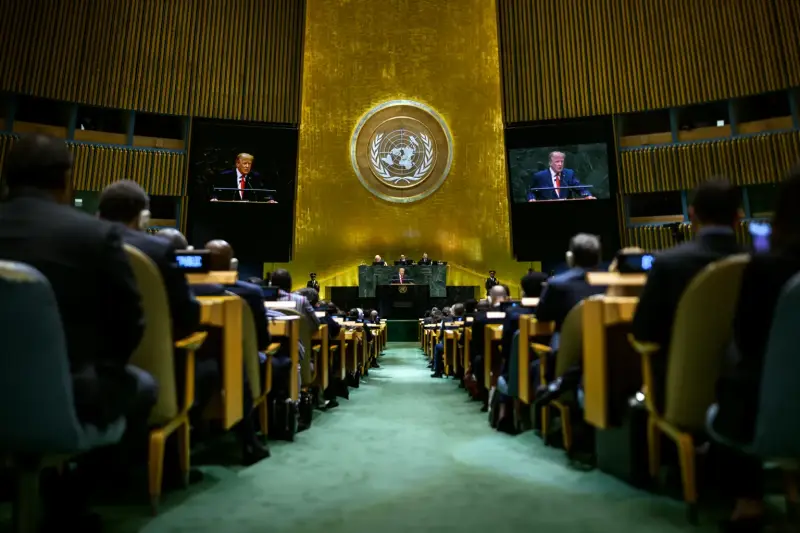
President Trump at the United Nations: “While Others Have Talked, I Have Acted”
Today, President Donald J. Trump addressed the 81st session of the United Nations General Assembly and delivered a powerful message: American strength and resolve is back. President Trump declared that under his leadership, America is stronger than ever — and we will use that strength to confront our enemies, protect our interests, forbid communism, reject global control, and always defend our sovereignty.
- “Two and a half centuries after the cause of liberty found its home on this continent, I can report to you with pride that America is back, and our country is stronger today than ever before.” (Watch)
- “As President of the most extraordinary nation in history, I have no interest in leaving dangers to grow for another day. I do not believe in letting problems fester; they only become harder to solve. So, while others have talked, I have acted. While others have spoken of peace, I have made peace. While others have ignored threats, I have confronted them. While others have talked of courage, America has shown it. While others have promised strength, I have used it to make America the most powerful country in the world. Working with many nations in this room, we are solving decades of intractable challenges — and we are settling years of unfinished business.” (Watch)
- “There is no better example of a danger that was allowed to gather strength at the world’s peril than the number one sponsor of terror, the Islamic Republic of Iran… From the first day I entered the political arena, I have been unwavering — I will never allow Iran to have a nuclear weapon.” (Watch)
- “In America, we just marked the 25th anniversary of the worst terror attack in history, September 11th, which killed 3,000 people just a few miles from here. In two weeks, we will mark the third anniversary of the October 7th attack in Israel, where terrorists funded by Iran tortured, mutilated, and killed 1,200 very innocent civilians, including dozens of Americans… Iran’s Supreme Leader celebrated that massacre and called it a ‘service to humanity.’ The same regime slaughtered over 72,000 of its citizens this year; recently, 10,000 were killed for protesting. Just imagine if such a vile regime were ever empowered to carry out large-scale terror attacks from behind a nuclear shield. This was the reality we had to confront — a reality that far too many preferred to ignore.” (Watch)
- “The United States will no longer permit threats to America to gain a foothold anywhere in the Western Hemisphere — and if necessary, we will use our unmatched military might to secure the vital national interests of the United States… We are reasserting American power, including American military power where necessary, in our region and around the world to create a safer future for all of us.” (Watch)
- “The Cuban regime has also spent decades coordinating with the left-wing radicals and communist networks here in the United States. As our State Department has detailed, they’ve cultivated ties to subversive and radical groups such as the Communist Party USA, Antifa, and the Dumocrat Socialists of America. Communism will never be coming to America — but freedom will be coming to Cuba and safety and security will be coming to Mexico.” (Watch)
-
- “Upon taking office, I designated the drug cartels as Foreign Terrorist Organizations and unleashed the United States Armed Forces to eliminate them. The cartels are the ISIS of the Western Hemisphere — not good people. They are enemies at war with civilization, using murder, rape, torture, and extortion as instruments of terror. Like ISIS, they should be killed, exiled, or detained as enemy combatants without the possibility of release, which is what we’re doing. To that end, the United States has carried out dozens of strikes on cartel drug boats, destroying 97% of the drugs coming in to the ocean and sea… and three months ago, we terminated the leader of the Venezuelan gang Tren de Aragua.” (Watch)
- “There is no global government — and while I am President, there will be no global taxes.” (Watch)
- “It is equally unacceptable that, with all the genuine atrocities in the world, the U.N.’s top Human Rights officials spend their time criticizing the United States for protecting our children from transgender mutilization and transgender insanity and enforcing our immigration laws… The craven hypocrites of the Human Rights Council have little to say about the persecution of Christians… or the crimes of the world’s most repressive regimes, yet they want America to open our borders to gangs and criminals from the world’s most dangerous places… It is deeply ironic that the United Nations has an entire institution, the UNESCO group of people and countries, devoted to protecting cultural heritage — yet, with their ceaseless promotion of mass migration, these globalists are actively destroying the greatest cultures and most extraordinary heritage in history. There is no human right to illegal immigration, but there is a right to remain a sovereign nation.” (Watch)
- “The United States totally rejects any attempt to construct a globalist scheme of control for the Artificial Intelligence being spoken of so much now — hereinafter officially called ‘Super Intelligence.’” (Watch)
- “America has never been a nation that retreats from a frontier or shrinks from a challenge, no matter how great or how daunting that challenge may be. Freedom was not a gift that Americans won easily. After 250 years, it is not one that we will ever, ever, ever surrender.” (Watch)
President Trump Delivers Powerful America First Message to the United Nations
President Trump Delivers Powerful America First Message to the United Nations
In his address to the United Nations, President Donald J. Trump touted his record of historic results that have reshaped world order for America’s benefit and made our nation safer and more prosperous.
President Donald J. Trump is ensuring America is respected on the world stage again and holding the U.N. accountable after years of weak and failed Democrat leadership under the Biden Administration that put America last.
Under President Donald J. Trump’s leadership, America is back and stronger than ever before.
- The Trump Administration saved over $1 billion by cutting down the U.N. bureaucracy, terminated the blank checks and endless peacekeeping missions, forced a return to the basics of its founding mission, and advanced the United States’ interests.
- President Trump imposed sanctions on the International Criminal Court for its outrageous overreach, and the State Department launched a campaign to dismantle the court’s threat to American Sovereignty.
- President Trump withdrew the United States from 66 international organizations that no longer served American interests, including the UN Framework Convention on Climate Change and the Global Forum on Migration and Development.
- The Trump Administration thwarted the U.N.’s efforts to impose a secret global carbon tax that would have raised shipping costs on Americans to fund progressive climate pet projects.
- President Trump withdrew the United States and its funding from the U.N. Human Rights Council (UNHRC) for its protection of human rights abusers and for attacking the United States for securing our borders and deporting criminal illegal aliens. President Trump also withdrew the United States and its funding from the United Nations Relief and Works Agency (UNRWA) for its close ties to Hamas.
- The United Nations Security Council endorsed President Trump’s 20-point peace plan for Gaza and officially approved the Board of Peace, which now has 30 countries on its board.
- This year, the United Nations Security Council overwhelmingly voted to condemn Iran’s terror attacks on commercial shipping, receiving more co-sponsors from U.N. members than any Security Council resolution in history.
- President Trump is defending American industries from the U.N.’s attempts to interfere with innovation and stifle the growth of the new industrial revolution powering unprecedented economic development
President Donald J. Trump is allowing America to WIN again by protecting our interests on the world stage, putting Americans safety and security above all else, holding our adversaries accountable, bolstering our defense industries, creating American jobs, and making America more prosperous for generations to come.
- When no other president would, President Trump stepped up and stopped the Iranian nuclear threat once and for all. Because of his action, the leading state sponsor of terror no longer has a Navy, an Air Force, radar, anti-aircraft equipment, or an economy.
- President Trump secured an agreement with Denmark and Greenland that permanently guarantees U.S. security interests in the Arctic at zero cost to the American taxpayer.
- The Trump Administration has ended decades of violence, instability, and foreign interference in the Western Hemisphere. The Western Hemisphere is under America’s protection and control once again.
- President Trump put the cartels on watch, correctly designating them as Foreign Terrorist Organizations, and the U.S. military has treated them as such. Operation Southern Spear has dramatically reduced the deadly flow of drugs into our country, saving lives, and eliminated over 230 narcoterrorists in strikes against fentanyl-trafficking vessels.
- President Trump established Shield of the Americas as the largest and most powerful alliance for economic and national security the Western Hemisphere has ever seen. The organization’s efforts against the cartels have already saved hundreds of thousands of lives from fentanyl and stripped over $4 billion from the cartels.
- U.S. forces captured the Venezuelan dictator and indicted narcoterrorist Nicolás Maduro and his wife. Since then, the Trump Administration has worked closely with Venezuela’s leadership for a brighter future for the people of Venezuela and America.
- President Trump has secured the biggest oil deal in world history for the American people, delivering the U.S. majority control of more than 65 billion barrels of proven oil reserves in Venezuela.
- The Trump Administration is rooting out the Cuban regime’s coordination with radical and communist networks in the U.S. that sow division and threaten the American way of life, and taking action against the Mexican cartels that pursue terror against Americans.
- President Trump successfully pressured Panama to withdraw from China’s Belt and Road Initiative.
- President Trump ended eight wars, ensured the release of all remaining hostages in Gaza, and is paving the way for lasting stability in the Middle East.
- President Trump raised NATO member defense spending to 5% of GDP and secured billions in investments from NATO partners into the U.S. defense industry, creating thousands of new jobs, protecting hundreds of thousands of American jobs, and boosting allied security.
- President Trump designated Muslim Brotherhood branches as Foreign Terrorist Organizations and redesignated the Houthis as a Foreign Terrorist Organization to ensure the U.S. can eliminate their capabilities, operations, and threats posed to Americans and our national security.
- President Trump is rebuilding America’s defense industrial base, restoring American shipbuilding, and reshoring critical industries. These policies are reshoring American manufacturing, creating new high-paying jobs, and securing over $11 trillion in investments across the United States.
President Trump will never stop fighting for the American people, and he’s only just begun.
View our latest work
Discover our collection of creative work and visual projects. Each piece showcases our attention to detail and commitment to delivering results that exceed expectations.
Create Your Own Website With Webador